Read the fabric, not the promise
The image suggests a mood. The specifications describe the piece. Read both.

A beautiful photograph can tell you a great deal about styling and very little about how a garment will behave in your hands. Light can make a surface appear richer, a pose can disguise a tight sleeve, and a carefully chosen angle can leave construction details outside the frame. Enjoy the image, then look for the information that helps you understand the actual clothes. The two activities can support one another when each is given its proper job.
Start with a modest expectation: a product listing should make its important facts legible. You should be able to find the stated composition, care instructions, available measurements, and relevant details about lining, stretch, or transparency where those details are supplied. Those facts will not answer every question. They can, however, help you distinguish what is documented from what you are imagining.
Read the whole composition
A phrase such as cotton blend or rayon blend describes a category of material, while the percentages give a more specific account of the stated fiber content. Read them together. Avoid treating the first word of a title as a complete description. A garment's name may emphasize one aspect of its appearance or composition without expressing the entire mixture.
The U.S. Federal Trade Commission's textile-labeling guidance explains how fiber content is identified on covered products. For a shopper, the useful habit is to look for the complete disclosure and compare it with the language used elsewhere in the listing. If a title and a material table appear inconsistent, that is a reason to seek clarity rather than choose whichever version sounds more appealing. A composition is information about ingredients, not a ranking of garments by itself.
Avoid assigning quality purely by country of manufacture or by whether a fiber is described as natural or manufactured. The actual garment still has a construction, a finish, a fit, and care requirements. A material that suits one use may be a poor match for another. Begin with the conditions in which you expect to wear and maintain the piece.
Separate a fiber from a fabric
The fiber description does not explain the entire surface you see. Yarn, fabric structure, weight, and finishing can all influence the result. For shopping purposes, this means two garments with a similar stated composition may look and feel different. Treat a familiar fiber name as a starting point for questions rather than a complete prediction.
Look closely at the available views. Can you see a rib, a visible knit structure, a smooth woven surface, or an open pattern? Does the description distinguish those details clearly? Use the image to understand visible structure, while recognizing that a photograph cannot establish softness, recovery, or long-term durability. Those qualities require evidence beyond the styling image.
Pay attention to the way the garment is presented. An open-knit top photographed over another layer does not necessarily provide the same coverage when worn alone. A floating skirt photographed in motion may settle differently when still. The useful question is what the image actually shows and what remains outside its scope.

Ask what the construction needs to do
Construction details matter most when they affect the way you plan to use a garment. A fastening needs to be practical for you. A pocket needs to be positioned where you can use it comfortably. A sleeve needs to move with the layers you intend to wear. Read the listing for those specifics before allowing a general mood to make the decision.
Where detailed photographs are available, examine hems, closures, seams, and the points where different parts meet. You may be able to identify visible inconsistencies or a feature you particularly like. You cannot establish stitch strength or wash performance from an attractive close-up. Keep that limitation in mind rather than filling it with a reassuring adjective.
If the information is incomplete, decide how important the unknown is to you. A buyer who needs a particular closure or lining has a more specific question than someone choosing between two colors. It is reasonable to leave a garment unpurchased when the listing does not establish a feature essential to its intended use.
A composition is information about ingredients, not a ranking of garments by itself.
Put care beside the purchase decision
Care instructions describe part of the ongoing relationship with clothes. Read them before buying, especially when your routine depends on a particular washing method. A piece you love in a photograph may be less useful if maintaining it requires time, equipment, or services you are unlikely to use.
The actual care label should guide treatment of the garment you receive. GINETEX's care-symbol guide explains the internationally used symbol categories, including washing, bleaching, drying, ironing, and professional care. A general fiber preference does not replace the instructions for the finished piece. Trims, finishes, and construction can make care more specific than the main material name suggests.
Think about storage and preparation as well as washing. Will the piece fit into the way you organize your wardrobe? Can you prepare it easily for the occasions you have in mind? Practical compatibility can be an important part of satisfaction, even though it is difficult to communicate in a beautiful campaign image.
Read measurements as a separate layer of evidence
Material information and fit information answer different questions. Check whether the measurements describe the garment or an intended body range. A flat measurement, a circumference, and a body measurement cannot be exchanged without understanding what the table means. Compare like with like and look for any stated measuring method.
Use a garment you already own as a reference when appropriate. Choose one with a similar purpose and shape, and measure it carefully according to the same method. A close comparison can help you anticipate length and room, but it does not guarantee identical fit. Stretch, cut, and construction still influence the experience.
For sets, read the information for each piece. A single size choice has to work for both the top and the bottom. If your preferred fit differs between them, the set may require more consideration than two separates. Do not let the visual coherence of a matching outfit conceal a practical sizing question.
Keep the claims proportionate to the evidence
Words such as premium, buttery, heirloom, or investment can create an impression without telling you how the conclusion was reached. Look for the specific observation behind the word. Was the garment physically examined? Is the statement a material specification, a styling opinion, or a performance claim? Those are different kinds of information.
At Take Flight, product facts should remain tied to the documented listing and provider information. Editorial stock imagery is used for visual atmosphere and styling ideas; its garments are not presented as identical to store products. Documentary vetting also leaves physical performance untested. That boundary is useful because it lets the information stay honest about what has and has not been established.
Available customer feedback can add context when it clearly concerns the same garment, but it should be read carefully. A comment about fit may reflect personal preference, body measurements, or a different variant. Look for specific observations and patterns rather than treating a single enthusiastic or disappointed sentence as a complete assessment.
Make a decision you can explain
Before buying, summarize the reason in ordinary language. You like the shape, the listed measurements appear suitable, the stated composition meets your preference, and the care fits your routine. Or perhaps an important detail remains unclear, in which case waiting is the more comfortable choice. A useful decision does not require every uncertainty to disappear; it requires you to recognize which uncertainties matter.
Check delivery estimates and return conditions alongside the garment details. Make sure the timeline applies to the actual item and destination, and understand the authorization process before planning to send anything back. These operational facts do not establish fabric quality, but they are part of the experience a product promises to provide.
Good fashion information leaves room for desire without asking desire to replace evidence. The photograph can suggest a mood. The specifications can describe the piece. Your own needs can determine whether the two come together in a garment you will enjoy wearing. Read each part carefully, and let the purchase remain a considered choice.
Further reading
FTC textile-labeling guidance explains fiber disclosures. GINETEX's care-symbol guide explains the symbol system. These references provide general context, rather than physical test evidence for any Take Flight garment.
Explore the wardrobe
Pieces to explore alongside the story. Stock editorials are separate styling references.
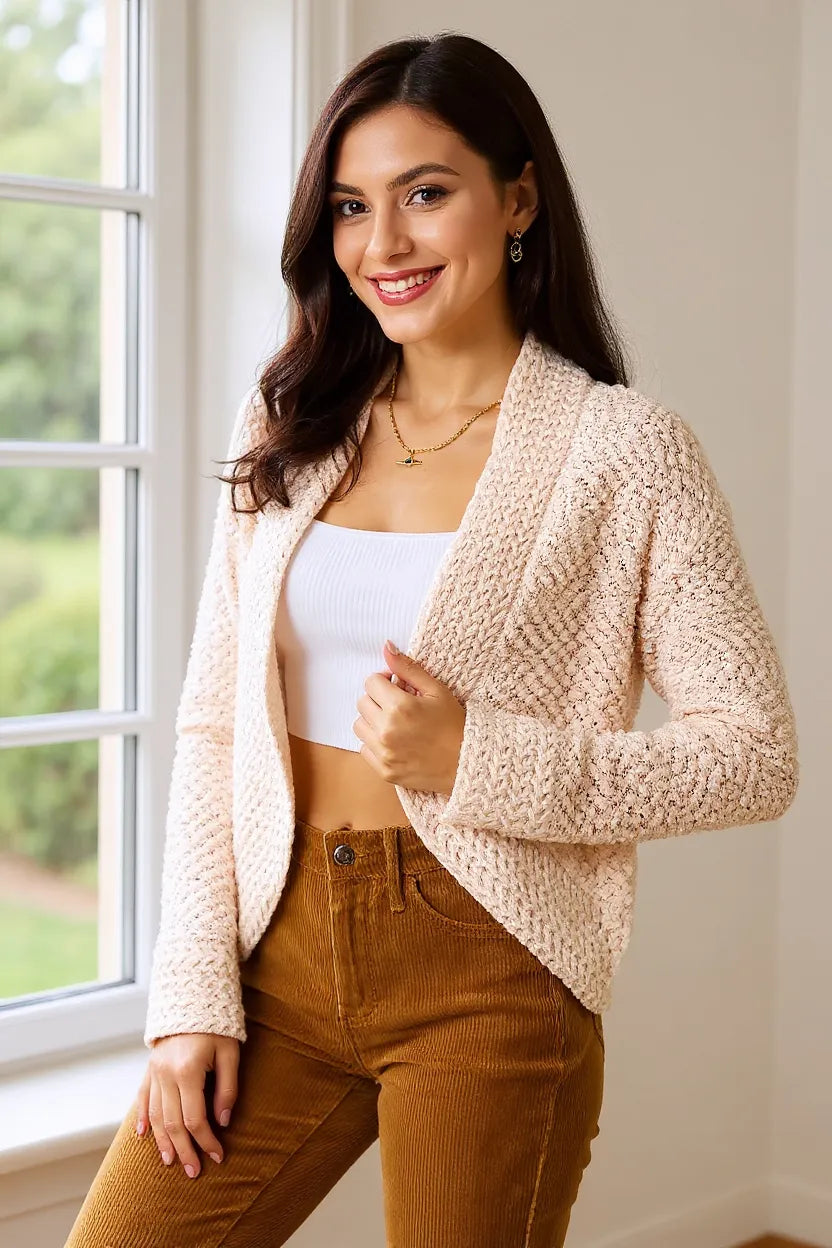
Open Front Cardigan — Cream
$36.00
Ribbed-Trim Open-Knit Top
$26.00Media credits
Photograph: Artem Podrez / Pexels. Editorial styling reference; garments and fabric pictured are not store products.
Source: https://www.pexels.com/photo/close-up-shot-of-a-beige-knit-textile-7232403/
Photograph: Artem Podrez / Pexels. Editorial styling reference; garments and fabric pictured are not store products.
Source: https://www.pexels.com/photo/close-up-shot-of-a-beige-knit-textile-7232403/
Stock license: https://www.pexels.com/license/